
Islamic Sensory Workshops for Babies: Gentle Activities and Rituals to Nurture Faith and Attachment
Introduction
The first years of a child's life are fertile ground for emotional, cognitive and spiritual awakening. More and more Muslim families are looking for caring, developmentally appropriate approaches to gently introduce the touchstones of faith. Islamic sensory workshops for babies combine sensory stimulation (touch, hearing, sight, smell, taste) with symbolic elements of Islam in order to create reassuring routines and positive associations with the religion. This in-depth article offers principles, detailed activities, protocols, precautions and resources for designing safe, respectful and effective workshops.
Why favour a gentle, sensory approach
- A baby's brain learns above all through direct experience and repetition; sensory stimuli shape neural networks.
- Introducing faith through the senses rather than through abstract explanations helps create positive emotional impressions that will last.
- Gentle, repetitive rituals provide a sense of security and attachment, which are fundamental to trust and to future openness towards more formal teachings.
- A non-coercive approach: the aim is awakening and attachment, not indoctrination. Respecting the child's pace is central.
Expected benefits for baby and family
- Stronger parent-child attachment through shared sensory interactions.
- Emotional soothing thanks to predictable routines that link music, scent and touch.
- Natural familiarity with the Arabic language, the rhythm of the Quran and key religious words.
- Motor and perceptual development through age-appropriate play.
- Intergenerational transmission of religious practices in a playful, modern form.
Educational and religious principles to respect
- Prioritise the baby's physical and emotional safety at every stage.
- Favour simplicity: short sessions, repetition and key words that are easy to remember.
- Respect the diversity of families and their religious and cultural preferences.
- Avoid all pressure: the workshop should be a space for exploration, not religious assessment.
- Involve parents and loved ones: their presence reinforces the effect of the stimulation.
Essential safety and precautions
- Avoid any small object that could be swallowed; favour non-toxic, washable materials.
- Do not use strong essential oils or lit incense near infants; instead use a lightly scented cloth that has been tested beforehand.
- Adapt the length of sessions to the child's age: 5 to 10 minutes for the very youngest, up to 30 minutes for those closer to 3 years old, depending on attention span.
- Watch for any sign of allergy or discomfort; consult your paediatrician with any questions about food and exposure.
- Maintain good hygiene: clean and disinfect handled objects regularly.
Neuroscience reference points
Research in affective neuroscience shows that repeated sensory experiences during early childhood have a lasting influence on the structure and function of the brain. Music and the prosody of Quranic recitation, for example, activate auditory and emotional circuits; skin-to-skin contact and touch nourish the stress-regulation system. Integrating religious elements within a secure, affectionate context means that faith becomes associated with pleasant, reassuring sensations, which later makes it easier for the child to embrace these practices consciously and willingly as they grow.
The structure of an Islamic sensory workshop: practical principles
- Clear routines: welcome, main activity, gentle transition and closing.
- Use of simple symbolic objects: small cloths, mini mats, tactile cards with Arabic letters, scented fabrics.
- Controlled audio support: slow recordings of short surahs, soothing nasheeds, the adhan at low volume.
- Time for parental observation: encourage the parent to note the child's reactions and preferences.
- Flexibility: each session adjusts to the pace of the group or of the baby.
Detailed activities by age group
0 to 3 months
- Soothing touch: caresses synchronised with the rhythm of breathing. Simple words in Arabic spoken softly to introduce the musicality of the language.
- Passive listening: play very short, slow extracts of the call to prayer or of short surah recitations, at low volume and in the presence of an adult.
- High visual contrast: mobiles with symbolic shapes (moon, star) in black and white to stimulate emerging vision.
- Gentle scenting: offer a square of cloth lightly soaked in rose water held at a distance, with no direct contact with the skin, after a prior test.
3 to 6 months
- Hand exploration: offer various fabrics (velvet, cotton, knit) while naming the texture and pairing it with a simple Arabic word.
- Touch ritual: lightly draw a star-shaped pattern on the back of the hand while saying a short dua for protection.
- Listening play: call the baby's name with different intonations and introduce a simple, repetitive nasheed.
6 to 12 months
- Safe sensory boxes: closed containers with coloured rice, fabric and soft shapes; encourage guided discovery.
- Tactile path: a small trail with varied textures where the child can crawl or walk with support.
- Introduction to vocabulary: introduce short Arabic words and their English meaning, repeated in songs.
12 to 18 months
- Gentle imitation games: reproduce everyday gestures such as placing a cloth on the head or sitting quietly, highlighting kindness.
- Sensory reading: tactile illustrated books on themes of nature and simplified Islamic values.
- Mealtime rituals: learning to say short words of thanks before and after eating.
18 to 36 months
- Arabic discovery workshops: rough letters to touch, simple Arabic shape puzzles.
- Islamic songs and rhymes: nasheeds suited to toddlers, without instruments if families prefer.
- Symbolic play: a mini prayer mat to sit on, short simplified stories of the Prophets told with tactile objects.
Concrete activity examples and detailed protocols
Morning ritual: a 7-minute protocol
- Calm setting: welcome the child and name the day for them.
- Waking music: play a short, gentle nasheed (30 to 60 seconds) while the parent softly strokes the chest or hands.
- Welcome scent: offer a square of scented cloth at a distance, then place a hand on the heart while saying a phrase of gratitude in Arabic and in English.
"Mini mat" tactile workshop: a 15 to 20-minute protocol
- Presentation: show a mini mat with different textures.
- Free exploration: let the child touch, push and feel the textures under supervision.
- Guided interaction: name the textures and link them to a simple name or attribute of Allah (for example, Ar-Rahman = loving), without heavy explanation.
- Closing: a short song and a blessing, then a transition to a restful activity.
Sound box: a 5 to 10-minute protocol
- A closed tactile box with a listening button: play an extract of a short surah or a slowly repeated dhikr.
- Encourage active listening: point towards the source of the sound, and gently have the child close their eyes to encourage auditory focus.
- Repeat over several sessions to build familiarity with and attachment to the rhythm of the Quran.
Recommended materials and budget
Here is a practical, affordable list to get an Islamic sensory workshop started:
- Varied textiles: offcuts of cotton, velvet, wool, organza (affordable and washable).
- Fabric mini mats: made locally for a low cost.
- Safe sensory boxes with lockable lids.
- Tactile cards with rough Arabic letters (DIY with card and adhesive materials).
- Audio recordings: royalty-free sources or local recordings by a reciter with a soothing tone.
- Scented fabrics: small tested squares, soaked in diluted rose water if the family agrees.
- Hygiene products: wipes, hand sanitiser for the adults, washing baskets.
DIY: making Islamic sensory tools
- Tactile cards: cut out card shapes, glue on different textures and draw an Arabic letter with a marker. Laminate or cover with a clear film for durability.
- Sensory mini mat: sew several rectangles of different fabrics side by side to create a tactile path.
- Homemade sound box: a sturdy plastic box with a small audio player that activates with pressure, containing a recording of a short surah at low volume.
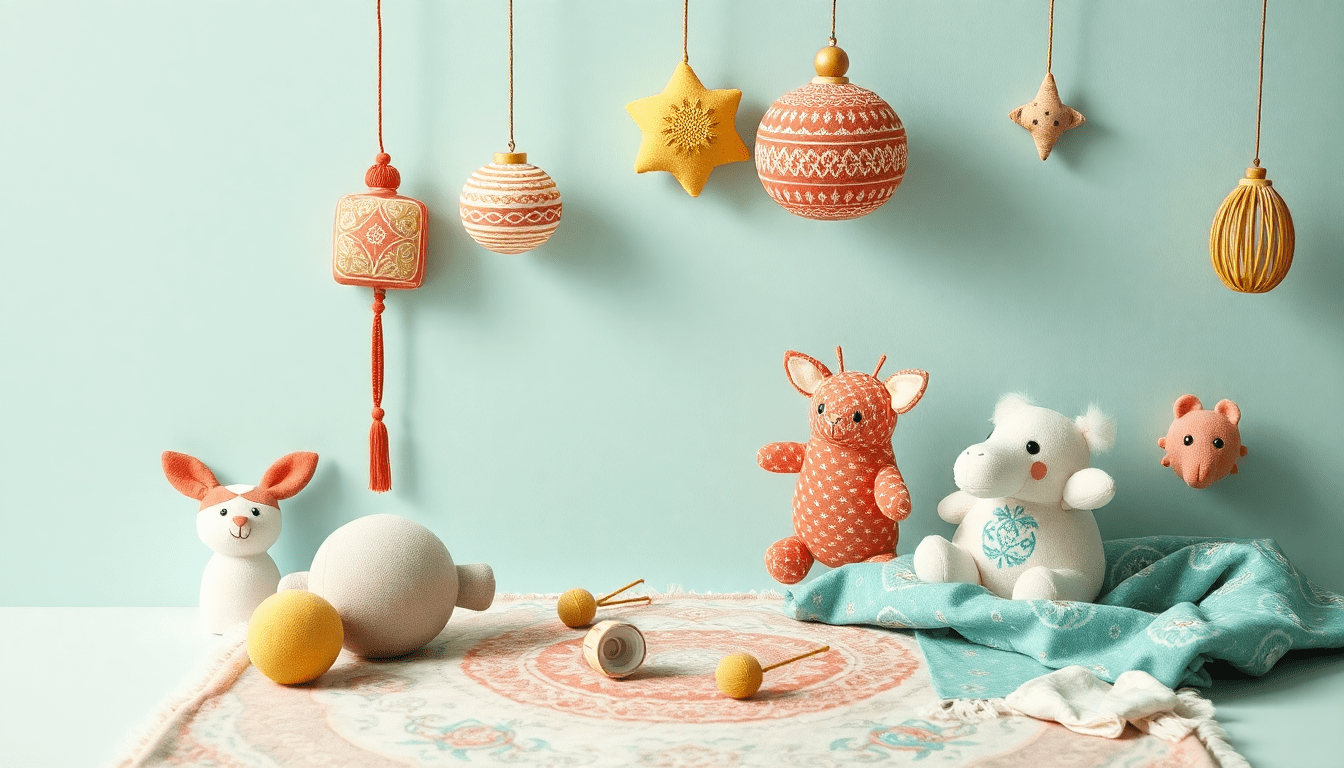
- Symbolic mobile: assemble felt shapes representing a moon, a star and stylised calligraphy; hang it above the play area.
Adapting for specific needs
Workshops can and should be inclusive. Here are a few recommendations for adapting the activities:
- For babies with sensory difficulties: reduce the stimuli, offer one modality at a time and allow more time to adjust.
- For families with specific religious preferences: adapt the audio content (avoiding certain instruments) and respect cultural preferences.
- For premature or very sensitive babies: consult the paediatrician and start with very short skin-to-skin sessions.
Practical tips for parents and facilitators
- Observe rather than impose: let the child show what interests them.
- Involve the parents: their presence reinforces the reassuring effect of the workshops.
- Encourage repetition: the same songs, the same fabrics and the same words help build stable associations.
- Document progress: a simple notebook where parents record the child's preferences and reactions is useful for adjusting sessions.
- Train the facilitators: a knowledge of the basics of child development and religious sensitivity are required.
Measuring impact: simple indicators
Assessing the effect of the workshops can be qualitative and easy to put in place:
- Immediate reactions: the baby calms down, smiles, vocalises or shows curiosity.
- Voluntary repetition: the child seeks to listen to or touch an object again.
- Increased vocalisations: first sounds or repetitions of simple words heard in the workshop.
- Parental feedback: noticing a sense of calm after the session or a new routine at home.
Marketing and setting up workshops
For educators or centres who wish to offer these workshops, here are some ideas for a respectful and well-received offering:
- Communicate about wellbeing and development rather than indoctrination.
- Offer free trial sessions and parent-child workshops to build trust.
- Collaborate with local mosques, parent associations and paediatricians to give the approach legitimacy.
- Use family testimonials and respectful photos (with parental permission) to show the reassuring environment.
Useful resources (books, apps, communities)
- Books for young children about Islamic values, written in simple language and illustrated.
- Music apps offering gentle nasheeds and slow recitations suited to toddlers.
- Parent groups on social media and forums to share activities, feedback and local adaptations.
- Short training courses for early-years facilitators and Islamic education for the adults leading the workshops.
Frequently asked questions (FAQ)
Do these workshops teach religion to babies?
No, not in the sense of formal instruction. They aim to create sensory and emotional reference points linked to faith, by fostering positive and reassuring experiences. Doctrinal teaching will come later, when the child is ready to understand.
At what age should you start?
You can start from birth with very gentle stimuli (touch, voice). The activities then increase in complexity up to 36 months and beyond.
Is it compatible with all religious sensibilities?
Yes, provided the workshop is designed with respect for the family's preferences. It is essential to talk with parents in order to adapt the audio and physical elements so that their beliefs are respected.
Can you use recordings from the local mosque?
Yes, with the appropriate permission and taking care over the volume, length and nature of the recordings to avoid any sensory overload.
Case studies and testimonials (fictional examples inspired by real feedback)
- Case 1, Family A: after 6 weeks of weekly workshops, the baby shows greater tolerance of bedtime routines and recognises a soothing song associated with prayer.
- Case 2, Centre B: parent-child workshops strengthened intergenerational bonds, with grandparents taking part in the readings and passing on rhymes.
Checklist for launching your first workshop
- Choose a quiet, warm and safe space.
- Prepare a washable, hypoallergenic materials kit.
- Put together a playlist of slow, soothing recitations and nasheeds.
- Train the facilitators in the basic principles of child development.
- Inform and involve the parents: a consent form and questions about allergies and preferences.
Examples of short phrases and duas suited to babies
Here are a few short phrases to weave in, in English and in Arabic, in a repeated and affectionate way:
- In Arabic: bismillah, meaning: in the name of Allah (to be said softly before a gesture).
When to use it: before a cuddle or a meal. - In Arabic: alhamdulillah, meaning: praise be to Allah (after a smile or a successful interaction).
When to use it: linking it to gratitude for the little things. - Naming Allah by simple attributes: Ar-Rahman (the Most Merciful), explaining briefly: the One who loves and protects.
Conclusion
Islamic sensory workshops for babies are a contemporary, caring response to the wish of many families for a gentle transmission of faith. By blending age-appropriate sensory stimulation, repetitive rituals and the Arabic language presented in a playful way, these workshops nurture attachment, emotional calm and an early familiarity with the symbolic elements of Islam. What matters most remains safety, respect for the child's pace and cooperation with the parents.
Would you like a detailed plan for a specific age group, a ready-to-use materials list or a facilitator training programme? We can provide a schedule of sessions, scripts for the songs and parental consent templates adapted to your context.
Further resources and references
To go further, look for recent works on the sensory development of infants, early-years educational resources and recordings of slow recitations produced specifically for toddlers. Do not forget to consult local paediatric guidance for anything relating to food and allergens.

Share:
Gentle Islamic Routines for Children: Soft Practices at Home to Awaken Faith, Calm and Confidence
Giving Eid Gifts in Islam: Ideas, Traditions and Inspiration to Delight Your Loved Ones